SuperMagSense

  • HOME
  • RESEARCH
    • 1. Concept
    • 2. GMR Sensor
    • 3. HTS Concentrator
    • 4. Hybrid sensor
  • PUBLICATIONS
  • TEAM
  • HOME
  • RESEARCH
    • 1. Concept
    • 2. GMR Sensor
    • 3. HTS Concentrator
    • 4. Hybrid sensor
  • PUBLICATIONS
  • TEAM
Project funded by the Executive Agency for Higher Education, Research, Development and Innovation Funding
Project number: PN-III-P1-1.1-TE-2016-2465
High sensitivity mixed superconducting-magnetoresistive magnetic field sensors for biomedical applications
"SuperMagSense"

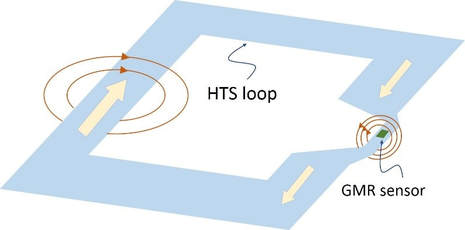
Recently, a new type of sensor capable of reaching sensitivities required for biomagnetic signal measurements has been proposed. It is a mixed superconducting-magnetoresistive sensor. It uses a superconducting ring with a small constriction as a magnetic flux-to-field transformer. When a magnetic field is applied perpendicular to the loop the supercurrent are generated in the loop to prevent the entrance of the magnetic flux in the superconducting loop (Meissner effect, which is a quantum effect). The supercurrent in the loop is given by:, were  is the inductance of the loop,  is its area and  is the component of applied magnetic field perpendicular to the loop. In the superconducting constriction, the supercurrent is distributed only in a superficial layer of thickness l, were l is the London penetration depth. Under these circumstances the magnetic field, B, created by the supercurrent in the vicinity of the constriction varies as the inverse of the width of the constriction, w. The gain, g, of the flux-field transformer varies as 1/w. For a loop with 20 mm in diameter the gain is of about g=1000  for w= 5 mm  and increases at 5000 as width decreases to 1 mm. The magnetic field produced by the screening current is amplified at the constriction, where a magnetic field, GMR sensor is placed (see figure below). 
Picture
Figure. Schematic representation of a mixed superconducting-magnetoresistive  sensor, showing the HTS loop, GMR sensor placed above the constriction and the magnetic field amplification at the constriction.
Powered by Create your own unique website with customizable templates.
